Your phone rings at 1:15pm. The receptionist is checking in a patient, the second line is busy with an insurance question, and the call rings out. A few minutes later, that caller has already found another clinic on Google Maps and booked there instead.
You’ll never know their name. You’ll never see them in your reports. And that’s exactly why missed calls are one of the most expensive problems a clinic can have while feeling like no problem at all.
In this article, we’ll look at why clinics in Dubai miss so many calls, how to work out what those missed calls actually cost your clinic in dirhams, and what you can do to stop losing patients to an unanswered phone.
Why clinics in Dubai miss so many calls
Most clinic owners underestimate how many calls go unanswered. It’s not because the team is careless. It’s because the phone competes with everything else happening at the front desk.
- Peak hours overlap with check-ins. Calls spike in the morning, at lunch and right after work, which are exactly the times the waiting room is busiest.
- One receptionist, too many jobs. The same person answers phones, greets patients, handles payments and deals with insurance approvals. Something has to wait, and it’s usually the phone.
- Patients call outside opening hours. Many people only have time to think about their health in the evening or on weekends. If your clinic closes at 8pm, every call after that goes to voicemail, and very few patients leave one.
- Language barriers slow things down. Dubai patients call in Arabic, English, Hindi, Russian and more. A call that needs to be passed to a colleague who speaks the language often gets dropped along the way.
- Holidays and staff gaps. Ramadan schedules, Eid, summer leave and sick days all leave the front desk thinner than usual, while patient demand doesn’t drop.
If any of this sounds familiar, your clinic is almost certainly missing more calls than you think.
How to calculate the cost of missed calls for your clinic
You don’t need a consultant to put a number on this. You need four figures, most of which your phone system and booking software already have.
- Missed calls per day. Check your phone system’s call log for unanswered calls, including after hours.
- Booking intent. What share of calls are from people wanting to book, rather than asking for directions or test results? A week of noting call reasons gives you a good estimate.
- Lost rate. How many of those callers never call back? Compare missed numbers against new bookings over the following days.
- Average value of a new patient visit. Use the average first-visit revenue for your clinic.
Then multiply them:
\text{Monthly cost} = \text{Missed calls per day} \times \text{Booking intent} \times \text{Lost rate} \times \text{Visit value} \times \text{Working days}A worked example
Here’s how it looks for a mid-sized clinic in Dubai. These are illustrative numbers, so swap in your own.
| Input | Example value |
|---|---|
| Missed calls per day | 8 |
| Share of calls wanting to book | 40% |
| Callers who don’t call back | 60% |
| Average first-visit value | AED 800 |
| Working days per month | 26 |
That works out to about 1.9 lost bookings a day, or roughly AED 1,500 a day and almost AED 40,000 a month in first visits alone.
And that’s the conservative version. It doesn’t include follow-up visits, treatment plans or the family members a happy patient refers. For specialties like dentistry, aesthetics or fertility, where one new patient can turn into months of treatment, the real number is much higher.
The hidden costs that don’t show up in your reports
Lost bookings are the obvious cost. But missed calls hurt clinics in quieter ways too.
Wasted marketing spend. You may be paying for Google Ads, Instagram campaigns or SEO to make the phone ring. When nobody answers, you’ve paid for a lead and thrown it away. For many clinics, the cheapest way to improve ad performance isn’t a new campaign. It’s answering the phone.
Damage to your reputation. Patients talk. “I called three times and nobody picked up” is the kind of thing that ends up in a Google review, and new patients read those reviews before they ever call.
Existing patients drift away. It’s not only new patients who call. Existing patients ringing to rebook or ask about results get frustrated too, and loyalty in a competitive market like Dubai is fragile.
A stressed front desk. When the phone never stops, your reception team works in constant catch-up mode. That affects how they treat the patients standing right in front of them, and it’s a big reason clinics struggle to keep good front-desk staff.
How to stop missing calls at your clinic
There’s no single fix, but these steps cover most of the problem.
1. Measure first
Pull your call logs for the last month. Look at missed calls by hour and by day. Most clinics find a clear pattern, like a lunchtime gap or a flood of calls after 8pm. Once you can see it, you can plan around it.
2. Call back fast
If a call is missed, call back within minutes, not hours. The longer you wait, the more likely the patient has already booked somewhere else. Make the missed-calls list part of your receptionist’s routine, not something checked at the end of the day.
3. Separate the phone from the front desk
If you can, don’t make the person greeting patients also answer every call. Even a part-time team member dedicated to calls during peak hours makes a visible difference.
4. Give patients another way to reach you
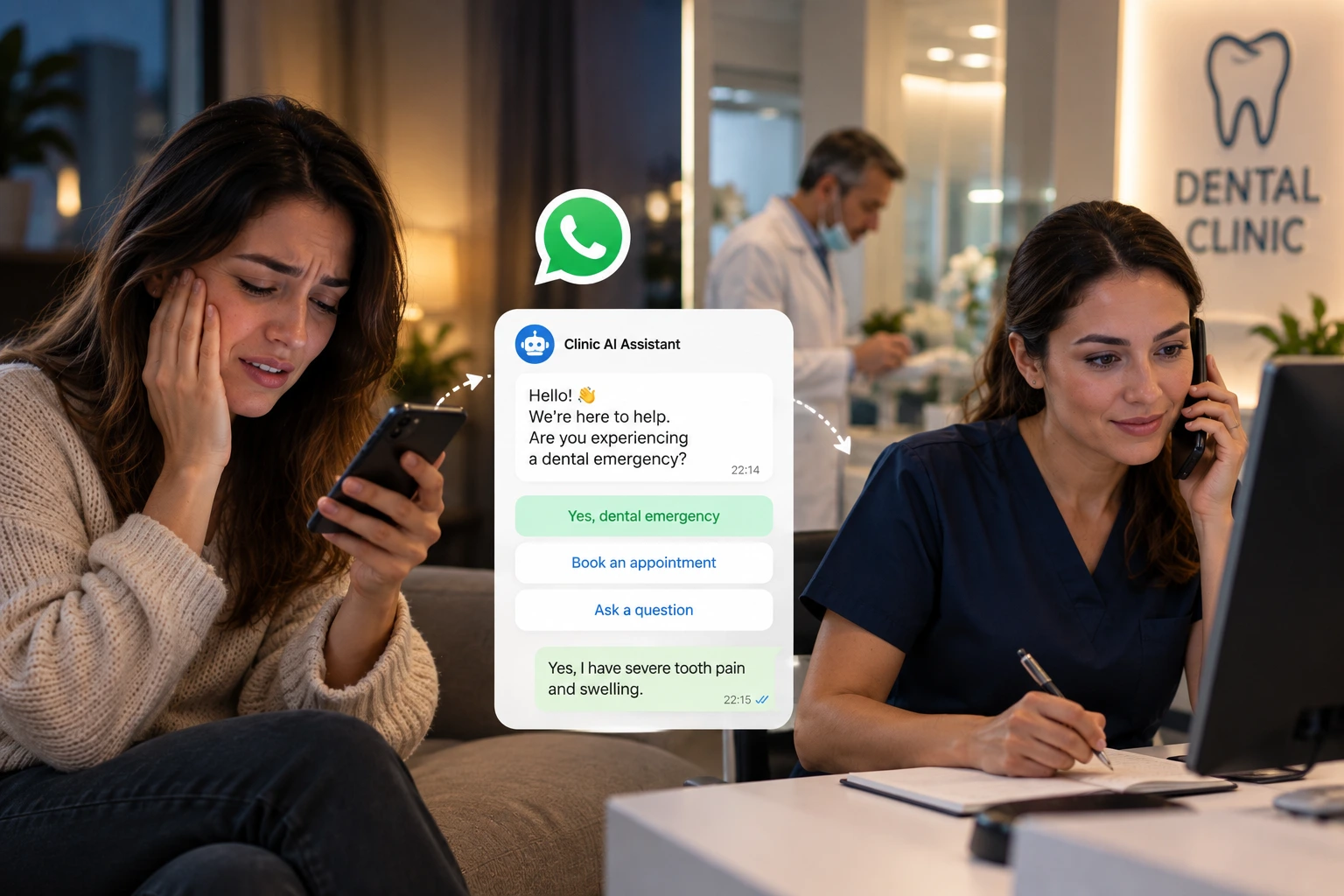
Many patients in the UAE would rather send a WhatsApp message than call. Put your WhatsApp number on your website, Google Business Profile and ads, and make sure someone (or something) replies quickly. It takes pressure off the phone line and catches patients who would never have called anyway.
5. Cover after-hours and peak times with an AI front desk
This is where most clinics hit a wall: you can’t afford to staff the phone 24/7, but patients call 24/7. An AI receptionist solves exactly that gap.
Rābetica answers your clinic’s calls and WhatsApp messages around the clock, speaks with patients in Arabic or English, answers common questions and books appointments straight into your calendar. When a call needs a human, it transfers it or flags it for your team. You can even talk to the voice agent on our homepage to hear how it sounds.
The result: no more rings into silence, and your team spends their time on the patients already in the clinic.
Missed calls and missed appointments often go together. If no-shows are also a challenge for your clinic, read our practical guide to reducing patient no-shows.
Frequently asked questions
How many missed calls is normal for a clinic?
It varies a lot by clinic size, specialty and staffing. Rather than chasing an industry average, track your own missed-call rate by hour and day. Any regular pattern of unanswered calls during opening hours, or a steady stream after closing, is worth fixing.
Do patients call back after a missed call?
Some do, but many don’t. Patients searching for a clinic often have several options open on Google Maps. If the first clinic doesn’t answer, it’s easy to simply call the next one, which is why a fast callback matters so much.
What is the best way to handle after-hours calls at a clinic?
Voicemail alone doesn’t work well, because most callers won’t leave a message. Better options are an answering service, a WhatsApp channel with fast replies, or an AI receptionist that can answer questions and book appointments at any hour.
Is an AI receptionist cheaper than hiring more front-desk staff?
For covering evenings, weekends and peak overflow, usually yes, because you’d otherwise need several shifts of staff to cover the same hours. Most clinics use an AI front desk alongside their team rather than instead of it, so receptionists can focus on patients in the clinic.
Can an AI receptionist speak Arabic?
Yes, good AI receptionists built for the UAE handle both Arabic and English. Rābetica detects the language the patient is speaking and responds in the same language.
Will an AI receptionist give patients medical advice?
It shouldn’t. A well-designed AI front desk handles bookings, questions about services, opening hours and directions, and passes anything clinical to your medical team. Rābetica, for example, does not give medical advice or prescriptions.
The bottom line
A missed call doesn’t look like much on its own. But for clinics in Dubai, where patients have plenty of choice and little patience, every unanswered call is a booking, a review and possibly a long-term patient walking out the door before they ever arrived.
The fix starts with knowing your numbers. Work out what missed calls cost your clinic using the formula above, and you’ll quickly see whether it’s a minor leak or a serious one. Then close the gaps: call back faster, open up WhatsApp, and let technology cover the hours your team can’t.
Curious how many calls your clinic is missing and what it would take to answer every one? Book a 30-minute call with the Rābetica team.