If you run a clinic, you’ve probably heard the term “AI receptionist” a lot lately. Some people picture a robot at the front desk. Others imagine a frustrating phone menu that never understands what you say. The reality is quite different, and for many clinics it’s become one of the most practical tools they’ve added in years.
An AI receptionist is software that answers a business’s phone calls and messages using conversational artificial intelligence. It talks with callers in natural language, answers common questions, books and reschedules appointments, and passes conversations to a human when needed, 24 hours a day.
In this guide, we’ll explain what an AI receptionist is, how it works behind the scenes, what it can and can’t do for a clinic, and how to choose the right one.
What is an AI receptionist?
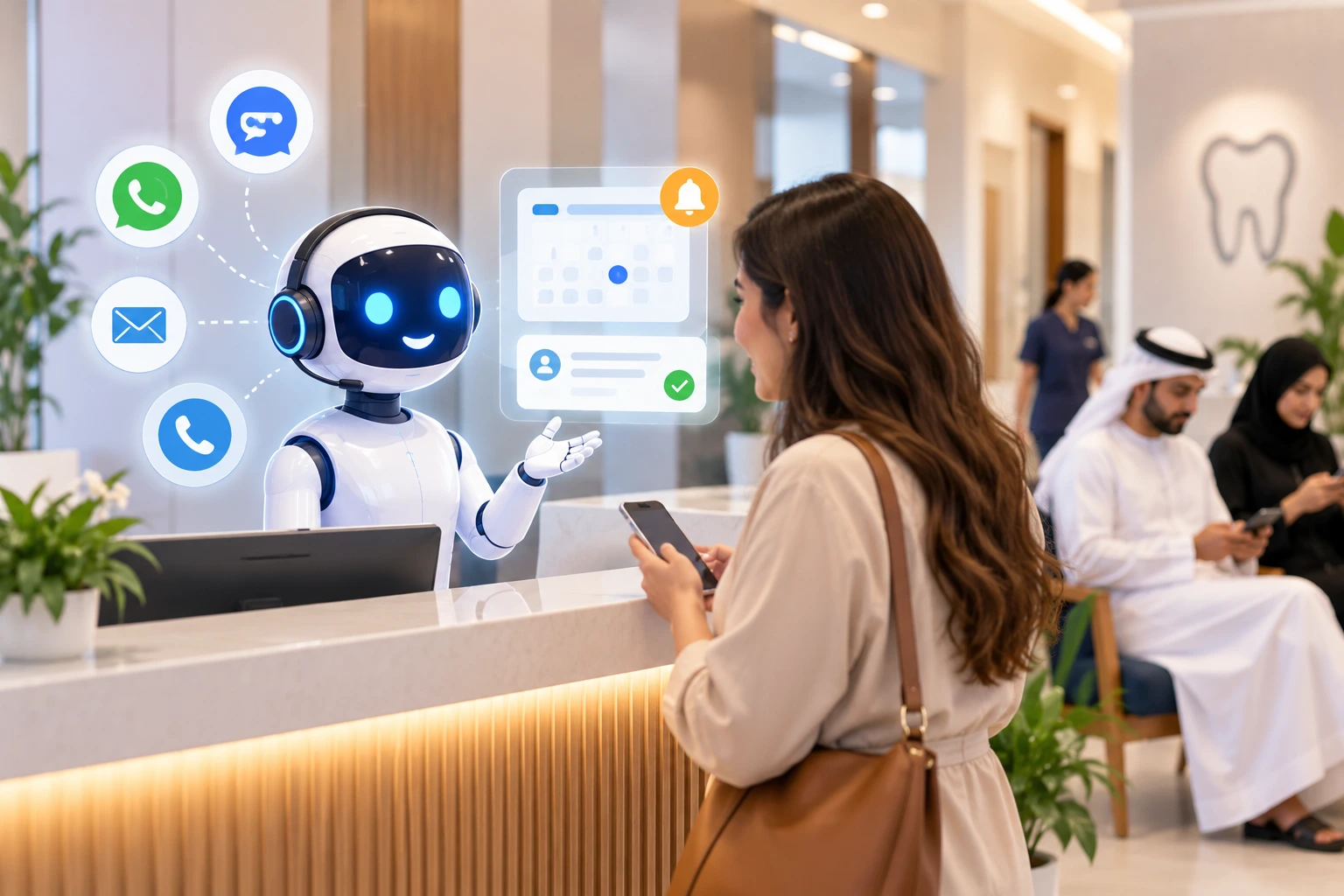
Think of an AI receptionist as a member of your front-desk team who never takes a break. It picks up the phone, replies to WhatsApp messages, and has real conversations with patients, not “press 1 for appointments” menus.
The difference from older phone systems is important. A traditional IVR (interactive voice response) system follows a fixed script and only understands button presses or a handful of keywords. A modern AI receptionist understands what people actually say, even when they phrase things differently, change their mind halfway through, or switch between Arabic and English.
You’ll also see it called an AI medical receptionist, AI phone receptionist, virtual receptionist or AI front desk. They all describe the same idea: AI that handles the routine side of patient communication so your human team can focus on the patients in the clinic.
An AI receptionist for clinics is different from a general-purpose one in a few ways. It’s connected to your booking system, it knows your doctors, services and opening hours, it follows healthcare-specific rules (like never giving medical advice), and it’s built to handle patient data carefully.
How does an AI receptionist work?
From the patient’s side, it simply feels like talking to a helpful receptionist. Behind the scenes, a few things happen in a fraction of a second.
1. It hears or reads the patient
On a phone call, speech recognition turns the caller’s voice into text in real time. On WhatsApp, the AI reads the message directly. Good systems handle accents, background noise and voice notes.
2. It understands what they want
A large language model works out the intent behind the words. “Can I see someone about my knee this week?”, “I need an orthopaedic appointment” and “do you have anything Thursday for a sports injury?” all mean roughly the same thing, and the AI recognises that.
3. It checks your clinic’s information
The AI looks up the facts it needs: which doctors treat that condition, which slots are free, prices, insurance accepted, opening hours, location. This comes from your booking system and a knowledge base set up for your clinic, so answers are based on your real information, not guesses.
4. It takes action
If the patient wants to book, the AI offers available times, confirms the details and writes the appointment straight into your calendar. It can also reschedule, cancel, send directions or share a price list.
5. It responds naturally
The reply is generated in the patient’s language and, on calls, turned back into speech with text-to-speech that sounds natural rather than robotic.
6. It hands over when it should
If the request is clinical, sensitive, complicated or simply something it doesn’t know, the AI transfers the call or flags the conversation for your team, along with a summary so the patient doesn’t have to repeat themselves.
You can hear this for yourself: the Rābetica homepage has a live voice agent you can talk to.
What can an AI receptionist do for a clinic?
Most of a receptionist’s day is repetitive communication. That’s exactly the part an AI receptionist handles well.
- Answer every call, including during peak hours, lunch breaks, evenings, weekends and public holidays.
- Reply on WhatsApp within seconds, including voice notes.
- Book, reschedule and cancel appointments directly in your clinic’s calendar.
- Answer common questions about services, prices, doctors, insurance, parking and opening hours.
- Send appointment reminders and handle the replies. (See our appointment reminder templates.)
- Speak the patient’s language, usually Arabic and English for clinics in the UAE.
- Share packages and offers when a patient asks about a treatment, helping turn enquiries into bookings.
- Follow up with patients who missed an appointment or didn’t finish booking.
- Escalate to your team when a conversation needs a human, with a summary attached.
AI receptionist vs human receptionist vs answering service
Clinics usually compare three options for handling patient calls. Here’s how they stack up.
| AI receptionist | Human receptionist | Call answering service | |
|---|---|---|---|
| Availability | 24/7, including holidays | Working hours, shifts | Often 24/7 |
| Calls at the same time | Many at once | One at a time | Depends on staff |
| Books appointments in your system | Yes, directly | Yes | Often takes messages only |
| Languages | Detects and switches automatically | Depends on the person | Depends on the agent |
| Yes | Yes, if time allows | Usually no | |
| Knowledge of your clinic | Full, from your setup | Full | Limited script |
| Empathy and judgement in complex cases | Limited, hands over | Strong | Varies |
| Cost to cover all hours | Low | High | Medium |
The honest takeaway: an AI receptionist isn’t a replacement for good people. It’s best at volume, speed and availability, while your human receptionist is best at empathy, judgement and the patients standing at the desk. Most clinics get the best results by using both.
The benefits of an AI receptionist for clinics
No more missed calls. Every unanswered call is a patient who might book somewhere else. An AI receptionist picks up every time, including the calls at 9pm on a Friday. If you’ve never worked out what those calls are worth, our article on the true cost of missed calls shows you how.
More appointments from the same demand. You’re already paying to make the phone ring through ads, SEO and referrals. Answering faster and booking on the spot turns more of those enquiries into actual visits.
Fewer no-shows. Automatic reminders, easy rescheduling and quick replies mean fewer forgotten appointments and more cancelled slots refilled in time. Read more in our guide to reducing patient no-shows.
A calmer front desk. When routine calls and messages are handled automatically, your receptionists can give their full attention to patients in the clinic. That’s better for patients and better for staff retention.
A better patient experience. Patients get answers immediately, in their own language, on the channel they prefer, at whatever time suits them. That’s increasingly what people expect.
Consistent answers. An AI receptionist gives the same accurate information every time, from prices to preparation instructions, as long as your clinic’s knowledge base is kept up to date.
What an AI receptionist shouldn’t do
A good AI receptionist knows its limits. In a clinic, that matters more than in almost any other business.
- No medical advice. It shouldn’t diagnose, suggest treatments, interpret results or prescribe. Anything clinical goes to your medical team.
- No guessing. If it doesn’t know an answer, it should say so and pass the question on, not invent something that sounds right.
- No handling emergencies alone. If a caller describes an emergency, the AI should direct them to emergency services and alert your team immediately.
- No trapping patients. Anyone who asks to speak to a person should be able to.
Patient data and privacy in the UAE
Patient conversations contain sensitive information, so where and how that data is handled matters. In the UAE, Federal Law No. 2 of 2019 on the use of ICT in health fields sets the default rule that health data related to healthcare services provided in the UAE must be stored and processed inside the country, with only limited exceptions.
That makes data residency one of the first questions to ask any AI receptionist provider. Rābetica, for example, stores patient data in the UAE. Whatever provider you consider, ask where the data, backups and call recordings are stored, and check with your legal advisor that the setup fits your clinic’s obligations.
How to choose an AI receptionist for your clinic
Not every AI receptionist is built for healthcare. Before you sign up, ask these questions:
- Was it built for clinics? General AI phone tools often struggle with medical terminology, doctor schedules and patient privacy.
- Does it connect to your booking system? An AI receptionist that can only take messages is half a solution. It should check availability and book directly.
- Does it handle both calls and WhatsApp? In the UAE, you need both.
- How well does it speak Arabic and English? Test it yourself, with real questions, accents and a mix of both languages.
- Where is patient data stored? Look for UAE data residency and clear security practices.
- How does it hand over to humans? Ask to see exactly what happens when a patient wants a person or asks something clinical.
- Can you control what it says? You should be able to update services, prices, FAQs and rules easily.
- What does the reporting show? Good tools show you call volumes, bookings, missed opportunities and common questions.
- How long does setup take, and who helps? A good provider will configure it around your clinic, not hand you a blank dashboard.
The simplest test of all: call it. Spend five minutes trying to book, reschedule and ask awkward questions. You’ll learn more than any sales deck can tell you.
Frequently asked questions
What is an AI receptionist?
An AI receptionist is software that uses conversational AI to answer phone calls and messages for a business. It understands natural speech, answers questions, books appointments and transfers conversations to staff when needed, at any time of day.
How does an AI receptionist work?
It converts the caller’s speech to text, uses a language model to understand the request, checks the clinic’s booking system and knowledge base, takes action such as booking an appointment, and replies in natural speech or text. When something needs a human, it hands the conversation over.
Can an AI receptionist replace a human receptionist?
It can take over a large share of routine calls and messages, but most clinics use it alongside their team rather than instead of it. The AI handles volume, after-hours and repetitive questions, while staff focus on patients in the clinic and complex situations.
Is an AI receptionist safe for medical clinics?
It can be, if it’s built for healthcare. That means never giving medical advice, escalating clinical questions to staff, handling emergencies correctly and storing patient data securely. In the UAE, check that health data is stored inside the country.
Do patients know they’re talking to an AI?
They should. Being upfront builds trust, and what most patients want is a quick, accurate answer at a time that suits them. Patients should always be able to ask for a person.
Can an AI receptionist speak Arabic?
Yes. AI receptionists built for the UAE, like Rābetica, detect whether the patient is speaking Arabic or English and respond in the same language.
How much does an AI receptionist cost?
Pricing varies by provider, call and message volume, and features. Compared with staffing a phone line around the clock, an AI receptionist is usually far cheaper for covering evenings, weekends and busy periods.
How long does it take to set up an AI receptionist?
It depends on the provider and how your booking system is set up. Typically it involves connecting your calendar, adding your services, doctors and FAQs, and testing calls before going live.
The bottom line
An AI receptionist isn’t a gimmick or a robot replacing your team. It’s a practical way to make sure every patient who calls or messages your clinic gets a fast, accurate answer, in their language, at any hour, while your staff focus on the people in front of them.
The clinics getting the most from AI receptionists are the ones that treat it as part of the team: set up carefully, connected to the booking system, clear about when to hand over, and checked regularly.
Want to hear what an AI receptionist built for UAE clinics sounds like? Talk to Rābetica’s voice agent or book a 30-minute demo.