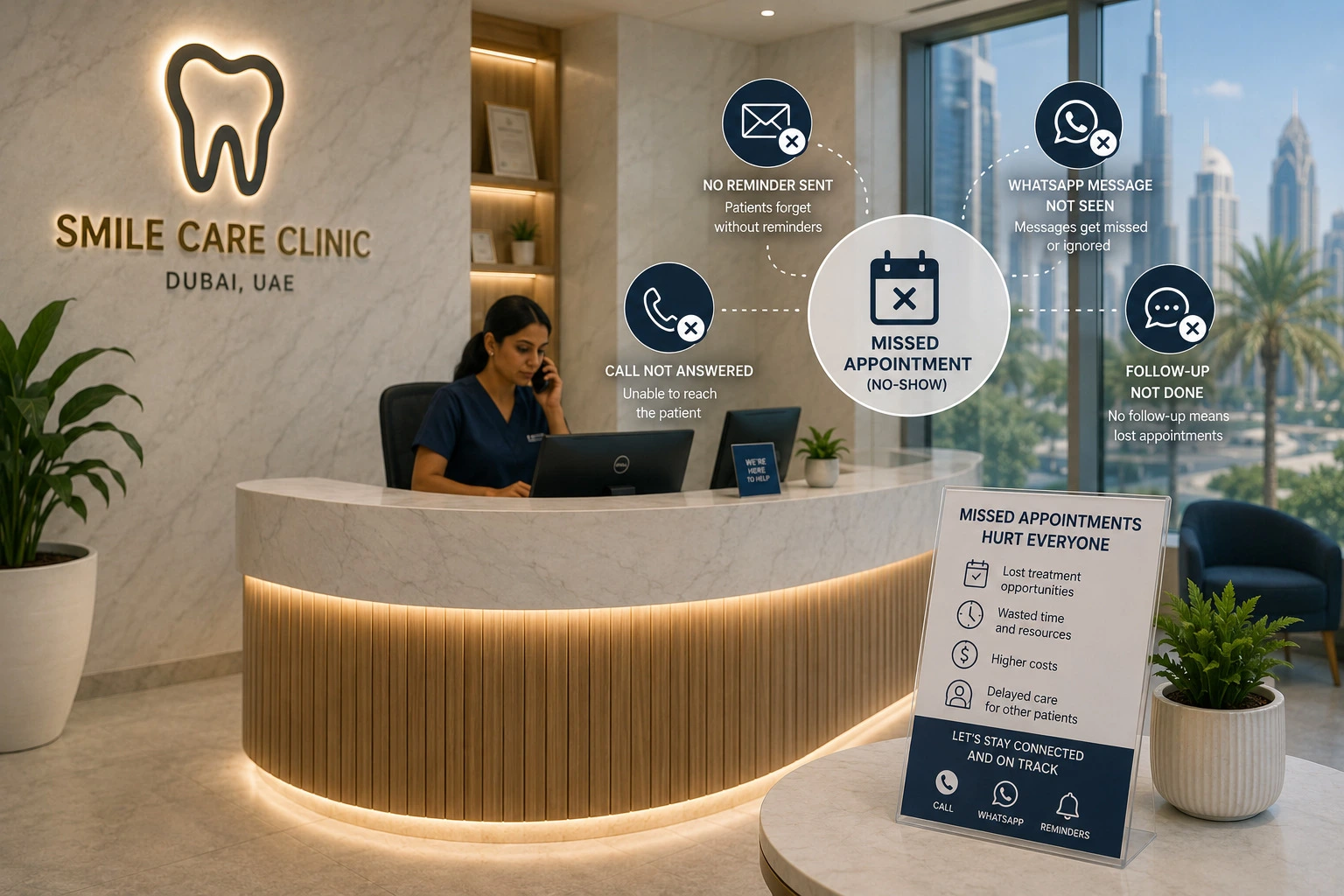
Every empty chair in your waiting room on a Tuesday afternoon was, at some point, a confirmed booking. For clinics across Dubai and the wider UAE, that empty chair is not a rare accident. It is a pattern, and in most cases it traces back to a single root cause: a breakdown in communication between the clinic and the patient.
No-shows are treated as a scheduling inconvenience by many practice managers. In reality, they are one of the clearest signals of how well a clinic communicates with its patients, and fixing them is one of the fastest ways to protect revenue without spending a single dirham on new patient acquisition.
What Counts as a No-Show, and Why It Matters More in the UAE
A no-show is a patient who was booked for an appointment and did not attend, and did not cancel or reschedule in advance. It differs from a late cancellation, though both create the same operational problem: a slot that could have gone to another patient sits empty.
In a market like Dubai, this problem carries extra weight. The city’s healthcare sector serves an unusually diverse, highly mobile population, with patients moving between insurance networks, switching clinics after relocating within the city, and juggling international travel schedules. Every one of those factors increases the chance that a booking made three weeks ago quietly falls off a patient’s radar by the time the appointment arrives.
How Bad Is the No-Show Problem in the UAE Right Now
The most direct evidence comes from Emirates Health Services, which operates primary healthcare centres across all seven emirates and handles more than 140,000 patient visits every month. A baseline review of EHS primary healthcare centres found a 21 percent no-show rate alongside average patient wait times exceeding 16 minutes, prompting the introduction of an AI-driven scheduling and analytics system to bring both numbers down. That is roughly one in five booked appointments never being used, inside one of the largest public healthcare networks in the country.
This is not just a UAE issue, but the region’s numbers sit inside a well-documented global range. A systematic review across healthcare settings put the mean missed-appointment rate at 15.2 percent, with a median of 12.9 percent, while a twelve-year study across ten clinics recorded an average no-show rate of 18.8 percent, with the highest rates occurring in subspecialist clinics. Industry benchmarking across appointment-based healthcare businesses more broadly places the medical practice average around 18 percent, with dental practices closer to 12 percent.
The UAE figure of 21 percent sits above most of these global benchmarks, which is a strong indication that something specific to how appointments are booked, confirmed, and reminded in this market is not working as well as it should.
The Real Cost of a Missed Appointment for a Dubai Clinic
The financial damage of a no-show is easy to underestimate because it never shows up as a single line item on a P&L. It shows up as an empty consultation slot, a doctor paid for time they did not use, front desk staff who prepared a file for a visit that never happened, and a patient on a waitlist who could have taken that slot instead.
Industry estimates put the revenue loss attributable to no-shows at 3 to 14 percent of a clinic’s booked capacity, a figure repeated across multiple healthcare operations studies. For a mid-sized Dubai clinic running a full daily schedule across several doctors, that percentage translates into real monthly losses, before accounting for the wasted marketing spend that went into acquiring the patient in the first place.
There is also a compounding effect that most clinics do not track: patients who miss one appointment are significantly more likely to miss the next one, and are at higher risk of dropping out of a treatment plan altogether. That matters even more in specialties like fertility, dermatology, and executive health, where continuity of care directly affects outcomes and where a single missed follow-up can mean restarting a diagnostic process from scratch.
Communication Gaps: The Hidden Driver Behind Most No-Shows
When researchers ask patients directly why they missed an appointment, the answers cluster around a handful of recurring themes, and communication failure sits at or near the top of almost every study.
Confusion, not defiance
A systematic review of general practice attendance found that a large share of missed appointments were not about patients forgetting or not caring, but about practical breakdowns such as confusion caused by the wrong date or time being recorded, appointments not being with a patient’s preferred doctor, or issues with the clinic’s booking system itself. In other words, the clinic’s own process created the gap.
Silence between booking and visit
Other research frames this even more starkly, estimating that up to 31.5 percent of no-shows stem from poor communication or a sense of disconnection between the patient and the provider, with patients who feel unheard or rushed significantly less likely to follow through on care. The same research found that a single missed appointment makes a patient 70 percent more likely not to return to that provider within 18 months, which turns a communication gap into a retention problem, not just a scheduling one.
Language and health literacy in a multicultural city
Dubai’s patient population is unusually diverse, with residents and visitors communicating comfortably in English, Arabic, Hindi, Urdu, Tagalog, Russian, and dozens of other languages. Broader research on missed appointments identifies language barriers and low health literacy as a factor that makes patients less likely to fully understand the importance of an appointment or the details of when and where it is happening. A reminder sent in the wrong language, or written in dense clinical wording, is functionally the same as no reminder at all.
One-way messages that ask nothing of the patient
A generic SMS that says “you have an appointment on Thursday” gives a patient information but does not ask for anything back. Clinics that rely only on this kind of one-way broadcast miss the chance to catch a problem early. When a reminder invites a reply, whether to confirm, reschedule, or ask a question, it turns a passive notification into an active commitment, and gives the clinic a chance to fill the slot in advance if the patient cannot make it.
What DHA Rules Mean for Your Cancellation Policy
Dubai Health Authority sets out clear expectations on both sides of the appointment relationship. Patients are expected to attend appointments on time and to inform the Medical Records Section at least 48 hours in advance if they need to cancel, and clinics are expected to provide patients with a written copy of their rights and responsibilities, including access to interpreter services when needed.
That 48-hour standard is a useful anchor for any clinic’s internal cancellation policy, but it only works if patients actually know it exists. A DHA-compliant cancellation clause buried in a consent form patients sign once and never see again does very little. Clinics that state this policy clearly at the point of booking, repeat it in reminder messages, and make interpreter or multilingual support genuinely accessible are simply following through on what DHA already expects, while also closing the exact communication gap that drives no-shows.
How to Close the Communication Gap and Reduce No-Shows
Use the channel patients actually check
WhatsApp is the dominant messaging platform across the UAE, and healthcare providers using it for reminders report open rates far higher than SMS or email, with WhatsApp reminders showing around a 98 percent open rate compared to roughly 82 percent for SMS. A reminder sent through a channel the patient rarely opens is a reminder that effectively was never sent.
Make confirmation two-way, not one-way
A message that simply informs is weaker than one that asks for a response. Confirmation flows that require the patient to reply “yes,” tap to confirm, or select a new time give the clinic a live signal well before the appointment date, rather than an empty chair as the first indication something went wrong.
Communicate in the patient’s language
For a clinic serving Dubai’s international patient base, having reminder templates ready in Arabic, English, and the two or three other languages most common among your patient list is not a nice-to-have. It is the difference between a message that gets acted on and one that gets ignored or misunderstood.
Layer your reminders
Timing the reminder sequence, typically 48 hours before an appointment and again around 2 hours before, has been shown to meaningfully cut no-show rates compared to a single reminder sent too early or too late to be top of mind.
Flag and personally follow up with high-risk patients
Not every patient needs the same level of outreach. Patients with a history of missed visits, new patients unfamiliar with your clinic’s process, or those booked far in advance benefit from a short, personal check-in rather than an automated message alone. This kind of targeted, human follow-up has been shown to meaningfully lower no-show rates among the patients most likely to miss their visit.
Review your no-show data every month
Most clinics can tell you their no-show rate only in a vague, anecdotal way. Tracking it by day of week, doctor, appointment type, and booking lead time turns a fuzzy problem into a specific, fixable one, and lets you target reminders and staffing decisions where they matter most.
Turning No-Show Data Into a Growth Strategy
Reducing no-shows is not only a defensive move to protect existing revenue. It is also a data source that most Dubai clinics leave completely untapped. Patterns in your no-show data can reveal exactly where your booking process, patient communication, or online presence needs work, which directly informs how a clinic should approach its local SEO, Google Business Profile management, and patient acquisition strategy going forward. A clinic that fixes its communication gaps internally also tends to see this reflected externally, in stronger reviews, better patient retention, and a healthier return on every marketing dirham spent bringing a new patient through the door.
Conclusion
No-show rates in UAE clinics, sitting around 21 percent in some of the country’s largest healthcare networks, are not simply a scheduling nuisance. The research is consistent across the UAE and globally: most missed appointments trace back to a communication breakdown, whether that is language, an unclear cancellation policy, a one-way reminder nobody reads, or silence between the booking and the visit. Clinics that treat patient communication as seriously as clinical care, through multilingual, multi-channel, two-way outreach, consistently see fewer empty chairs and stronger patient relationships as a result.