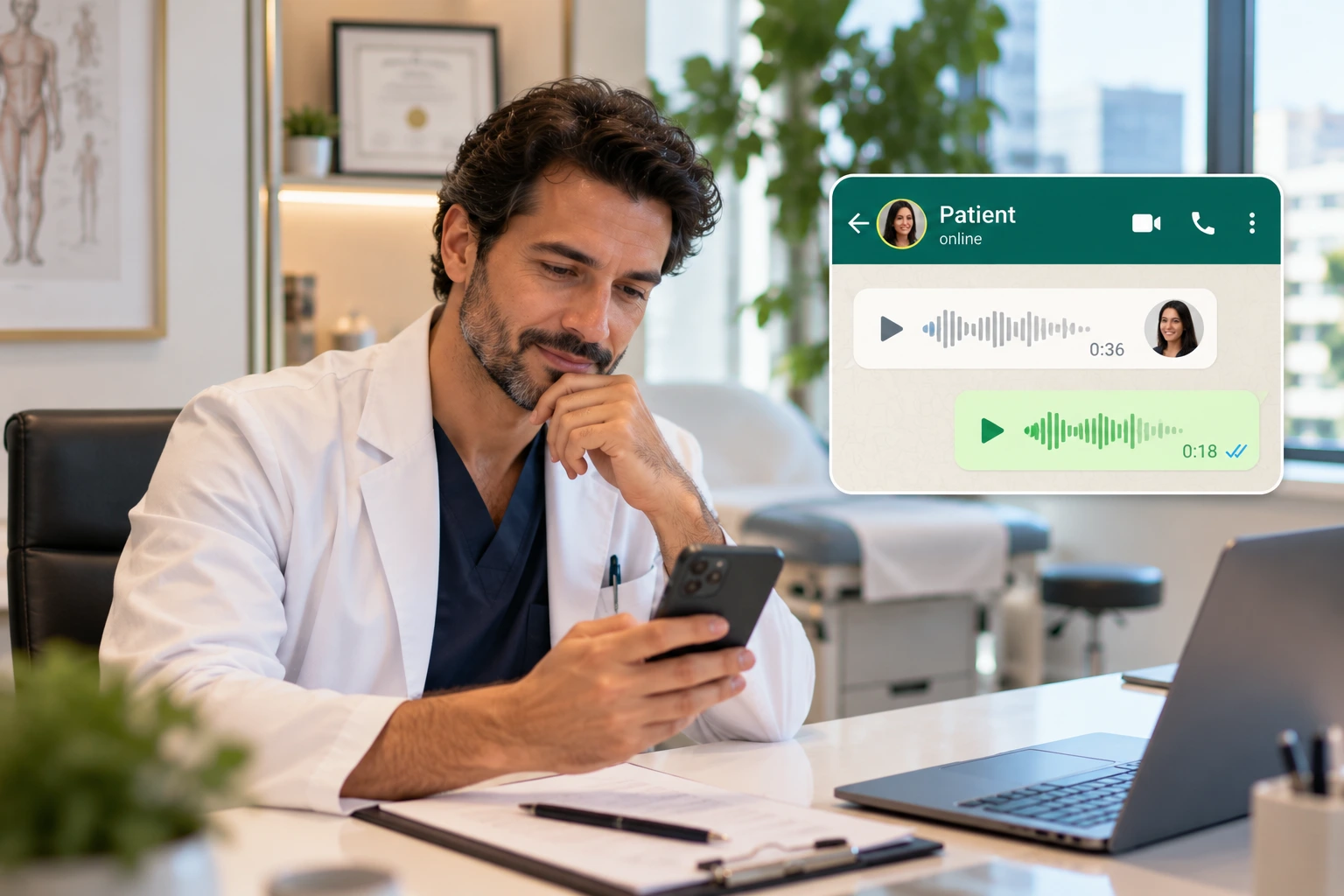
Your receptionist opens WhatsApp. Three new messages. Two are voice notes, one is 42 seconds, the other is two minutes and fifteen. The waiting room is full, the phone is ringing, and there’s no quiet corner to listen.
If that sounds familiar, you’re not alone. In the UAE, many patients prefer to speak rather than type, especially when they’re explaining something personal, writing in Arabic on an English keyboard is awkward, or they’re simply driving. For patients, voice notes are easy. For clinics, they can quietly become one of the most time-consuming and risky parts of WhatsApp.
The answer isn’t asking patients to stop. It’s having a clear way to handle WhatsApp voice notes quickly, privately and safely. Here’s how.
Why patients send voice notes
Understanding why patients choose voice helps you respond the right way.
- It’s faster than typing, especially for longer explanations.
- It’s easier in Arabic. Many people find speaking Arabic far more natural than typing it, and dialect doesn’t always fit neatly into text.
- They’re on the move. Driving, carrying children, walking between meetings.
- It feels more personal. Tone of voice carries worry, urgency or politeness in a way text doesn’t.
- Some patients find reading and writing hard, whether because of eyesight, literacy or language.
- Older patients and family members often find voice notes simpler than typing.
In other words, voice notes are often a sign that the patient wants to communicate the way that’s most comfortable for them. That’s worth respecting.
Why voice notes are hard for clinics
- You can’t skim them. A two-line text takes seconds to read. A two-minute voice note takes two minutes, every time someone needs to check it.
- They need quiet. Listening at a busy reception desk is difficult, and playing them out loud is a privacy risk.
- The important bit is often buried. “Hi, I hope you’re well, so last week I came in and…” before the actual request, 90 seconds later.
- Details get missed. Dates, times, names and phone numbers spoken quickly are easy to mishear.
- They’re hard to search and hand over. A colleague picking up the conversation has to listen again from the start.
- They may contain clinical information. Patients often describe symptoms in voice notes, which means they need clinical attention and careful handling.
- Language mismatches. An Arabic voice note in Gulf dialect may reach a team member who doesn’t speak it.
A simple voice note policy: 7 rules
1. Welcome them, don’t discourage them
Never reply “please send a text instead” as a default. For many patients, that feels dismissive. Accept voice notes as a normal part of WhatsApp.
2. Listen privately
Give front-desk staff headphones and make it a rule: voice notes are never played on speaker in reception or anywhere patients can hear.
3. Reply in text, and confirm the key details
Even when a patient sends a voice note, reply in writing. Text gives the patient something to refer back to, and it lets you confirm what you understood: “Just to confirm, you’d like to move your appointment with Dr. Fatima from Tuesday to Thursday afternoon. Is that right?” Dates, times, prices and instructions should always be in writing.
4. Leave a short written note in the chat or patient record
After listening, add a one-line summary for your team (“Wants to reschedule Tue 4pm → Thu pm”), so nobody has to listen again. Use transcription where it’s available and reliable.
5. Route by language
If a voice note is in a language or dialect you don’t speak well, pass it to a colleague who does, rather than guessing.
6. Flag clinical content immediately
If a patient describes symptoms, medication issues or anything worrying, treat it like a clinical message: send it to a nurse or doctor quickly, and reply to the patient with what happens next. If anything sounds urgent, direct the patient to emergency care straight away.
7. Set response-time targets
Voice notes shouldn’t wait longer than text messages just because they take more effort. Agree on the same target for both.
Reply templates
Confirming a request from a voice note
Thank you for your message, [Name]! Just to confirm, you’d like to [request]. Here are the available times:
- [Day] at [Time]
- [Day] at [Time]
Which suits you best?
شكراً لرسالتك [الاسم]! للتأكيد، ترغب في [الطلب]. هذه المواعيد المتاحة:
- [اليوم] الساعة [الوقت]
- [اليوم] الساعة [الوقت]
أي موعد يناسبك؟
When the voice note was unclear
Thank you for your voice message, [Name]. Part of it was a little hard to hear. Could you confirm the date you’d like, or send a quick text? Thank you!
When the voice note describes symptoms
Thank you for letting us know, [Name]. I’ve passed your message to our nurse, who will contact you shortly. If your symptoms are severe or getting worse, please seek urgent medical care or call 998.
When it’s a long message with several questions
Thank you, [Name]! I’ve noted your questions: 1) [question one], 2) [question two]. Here are the answers: [answers]. Anything else I can help with?
Privacy and clinical content
Voice notes often contain more personal information than text, because patients speak freely. Treat them with the same care as medical records.
- Never play voice notes where others can hear, including in the back office if other patients’ calls are happening.
- Don’t forward voice notes to personal phones or group chats. Keep them inside your clinic’s official WhatsApp system.
- Be careful with transcription tools. Some send audio to servers outside the UAE. Health data from care in the UAE generally needs to stay in the country, so check where any transcription happens. Our guide to patient data privacy in the UAE explains why.
- Avoid replying with voice notes for anything sensitive. The patient may play your reply on speaker, or near family. For sensitive specialties, see our guide to private, sensitive patient communication.
- Clinical advice comes from clinicians. Receptionists should never answer medical questions from a voice note, however simple they seem.
Where AI fits in
AI has made voice notes much easier to manage. Modern speech recognition can understand spoken Arabic and English, pick out what the patient wants, and turn a rambling two-minute message into a clear request.
An AI front desk like Rābetica replies to WhatsApp messages in seconds, 24/7, in Arabic or English. It can book and reschedule appointments directly in your calendar, answer practical questions, and hand clinical or sensitive conversations to your team with a summary, so nobody has to listen again from the start. Ask us during a demo how it handles voice notes in your clinic’s setup.
Either way, your team spends less time listening and replaying, and more time with the patients in front of them. Learn more about how an AI receptionist works.
Frequently asked questions
Should clinics accept voice notes on WhatsApp?
Yes. Many patients in the UAE find voice notes easier than typing, especially in Arabic or when they’re on the move. Clinics should welcome them and have a clear process for handling them.
Should clinics reply to voice notes with voice notes?
Usually it’s better to reply in text. Written replies let patients refer back to dates, times and instructions, and they’re more private if the patient’s phone is near others.
How can a busy front desk handle voice notes faster?
Use headphones, reply in text confirming the key details, add a short written summary for colleagues, route by language, and use reliable transcription or an AI front desk to understand and act on routine requests.
Are WhatsApp voice notes from patients health data?
Often, yes. If a voice note mentions symptoms, treatment, appointments or other health information, treat it as health data and handle it securely.
What should a clinic do if a voice note describes symptoms?
Pass it to a nurse or doctor promptly and tell the patient what will happen next. If the symptoms sound urgent, direct the patient to emergency care immediately.
Can AI understand Arabic voice notes?
Modern speech recognition can understand spoken Arabic, including many dialects, though quality varies between tools. Test any tool with real voice notes in the dialects your patients use.
The bottom line
Voice notes aren’t going away. For many patients in the UAE, they’re the most natural way to talk to their clinic. The clinics that handle them well don’t fight the habit. They listen privately, reply clearly in writing, flag clinical content fast and use technology to take the effort out of it.
Do that, and voice notes stop being a bottleneck and become what patients intended: a quick, personal way to reach you.
Want WhatsApp messages answered in seconds, in Arabic and English? Book a 30-minute demo with Rābetica.