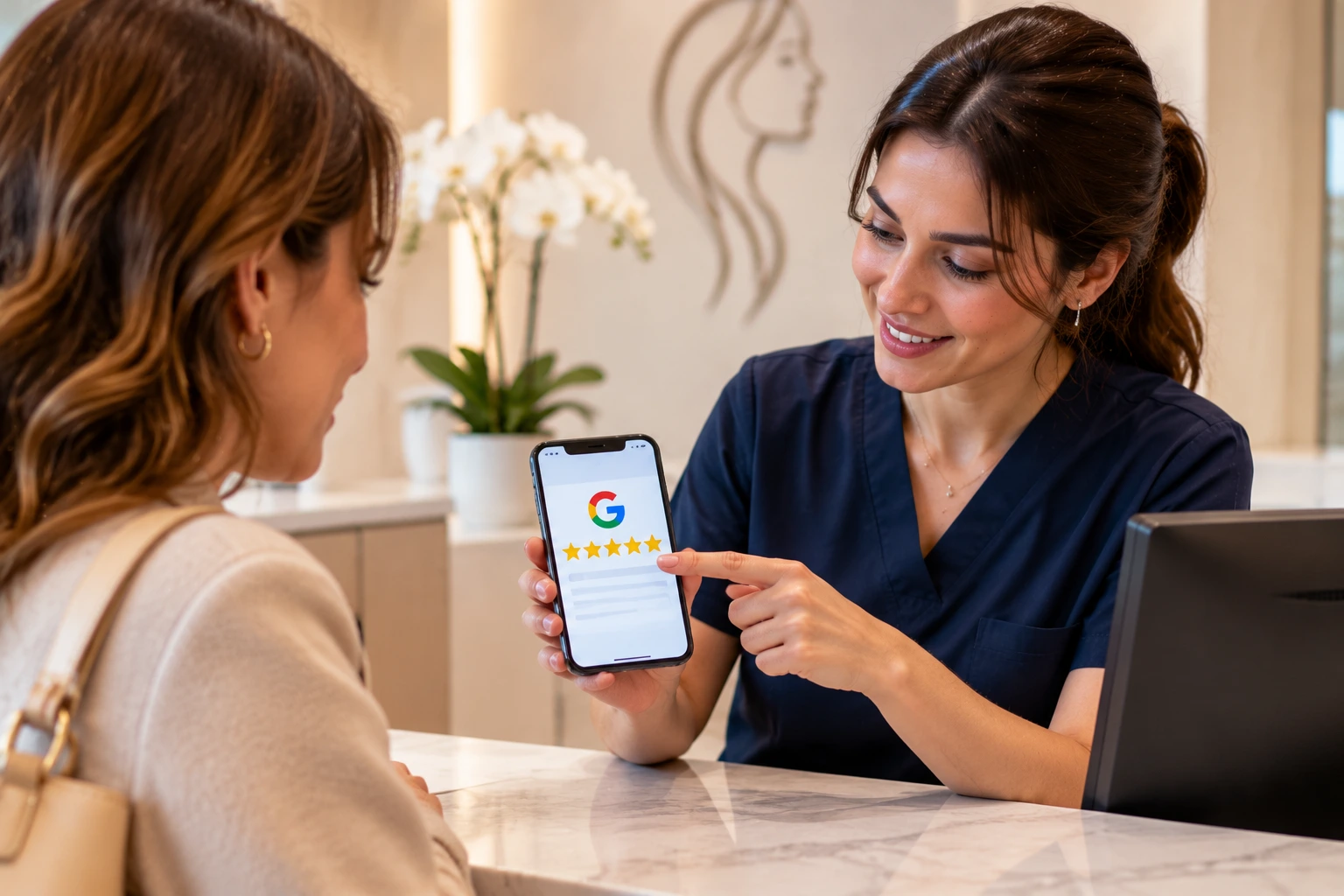
Your patients leave happy every day. They thank the doctor, smile at reception, maybe even tell a friend. But when someone in Dubai searches for a clinic like yours, what they see first is your Google rating and the reviews underneath it. And many happy patients never write one.
It’s not because they don’t want to. Nobody asked them, or they were asked at the wrong moment, or the link was hard to find.
WhatsApp fixes most of that. It’s where your patients already are, it lets you ask personally, and a link is one tap away. This guide shows how to ask patients for Google reviews on WhatsApp the right way: at the right time, in the right words, within Google’s rules and without compromising anyone’s privacy.
Why Google reviews matter so much for clinics
- They shape first impressions. Patients compare ratings and read recent reviews before they ever call.
- They help you appear in local search. Reviews are one of the signals that influence how businesses show up in Google Maps and local results.
- They build trust for nervous patients. Someone considering a first dental visit, a fertility consultation or a cosmetic procedure wants to hear from people like them.
- Recent reviews matter. A clinic with plenty of reviews but none in the last year can look less active than it is.
- They’re feedback. Reviews tell you what patients love and what frustrates them.
The rules: what Google doesn’t allow
Before you start, know the lines you can’t cross. Google’s policies for reviews mean clinics should not:
- Offer incentives such as discounts, free treatments or gifts in exchange for reviews.
- Ask only happy patients. Selectively inviting patients you expect to be positive, sometimes called review gating, isn’t allowed. Ask everyone, or ask without filtering by expected sentiment.
- Write or post fake reviews, or ask staff, friends or family to review the clinic.
- Pressure patients or ask them to change or remove a negative review in return for something.
Also check your health authority’s advertising rules before reusing patient reviews in ads or on social media. Healthcare advertising in the UAE is regulated.
When to ask
Timing makes a huge difference. Ask too early and the patient hasn’t experienced the result. Ask too late and the moment has passed.
- Routine visits (check-ups, consultations, cleanings): a few hours after the appointment, or the next morning.
- Treatments with visible results (aesthetics, dental work, laser): once the result is visible and the patient is happy, often at or after the follow-up visit.
- Longer journeys (pregnancy care, fertility, orthodontics): at a natural milestone or at the end, never during a stressful phase.
- After a patient compliments you. If someone messages “thank you so much, Dr. Sara was amazing”, that’s the perfect moment to ask kindly.
When not to ask: after bad news or a difficult diagnosis, during a treatment that’s going badly, in any situation involving loss or grief, or while a complaint is still being handled. This is about kindness and timing, not about filtering out unhappy patients. Every patient is free to review you at any time, and your process should ask all patients at the same point in their journey.
How to ask: five principles
- Make it personal. Use the patient’s name and the doctor’s name. A review request from “Dr. Ahmed’s team” gets more replies than one from “the clinic”.
- Keep it short. Two or three lines and a link. That’s it.
- Make it one tap. Send a direct link that opens the review box, not your homepage or a general Google search.
- Ask once, maybe remind once. One gentle reminder a few days later is fine. More than that feels like pressure.
- Respect privacy. Never suggest what to write, never ask patients to mention their treatment or condition, and remind them they don’t have to share anything personal.
How to get your review link
In your Google Business Profile, look for the option to ask for reviews or share a review form. Google gives you a short link that opens the review window directly. Save it in your WhatsApp quick replies or templates so every team member uses the same one.
WhatsApp review request templates
After a routine visit
Hi [Name], thank you for visiting Dr. [Doctor] today. If you have a minute, we’d really appreciate a short Google review. It helps other patients find us. 🙏
[Review link]
مرحباً [الاسم]، شكراً لزيارتك د. [اسم الطبيب] اليوم. إذا كان لديك دقيقة، يسعدنا جداً أن تشاركنا تقييمك على Google، فهذا يساعد مرضى آخرين في العثور علينا. 🙏
[رابط التقييم]
After a treatment with visible results
Hi [Name], we hope you’re enjoying your results! If you’d like to share your experience with our team, a Google review would mean a lot to us. There’s no need to mention any treatment details.
[Review link]
When a patient thanks you
Thank you so much, [Name]! We’ll pass that on to Dr. [Doctor]. 😊 If you’d be happy to say the same on Google, it really helps others choose with confidence: [Review link]
One gentle reminder (a few days later)
Hi [Name], just a quick follow-up in case you missed our last message. If you have a moment, we’d love your feedback on Google: [Review link]. Thank you either way!
For sensitive specialties (women’s health, fertility, mental health)
Hi [Name], thank you for trusting our team. If you’d like to share your experience, you’re welcome to leave a Google review. Please don’t include any personal or medical details. [Review link]
For sensitive specialties, decide as a clinic policy whether and when to send review requests, apply that policy consistently to all patients, and keep the wording especially discreet. Our guide to private, sensitive patient communication covers this in more depth.
Handling negative feedback
If a patient replies to your review request with a complaint, that’s valuable. It’s a chance to fix something before it becomes a public review, or to show how well you respond if it already is.
- Thank them for telling you.
- Move it to a person. A manager or senior team member should follow up, ideally by phone.
- Fix what you can, and tell them what you’ve changed.
- Don’t ask them to delete or change a review in exchange for anything.
Replying to Google reviews without breaking privacy
Replying to reviews shows you care, and future patients read your replies. But clinics have a duty of confidentiality, even when a patient has shared details publicly.
- Never confirm that someone is a patient, or mention their treatment, condition, visit date or doctor, unless it’s purely generic.
- Keep replies short and general. “Thank you for your kind words, we’re so glad you had a good experience with our team.”
- For negative reviews, take it offline. “We’re sorry to hear this. We take all feedback seriously. Please contact our patient care team at [number] so we can look into it.”
- Never argue or correct a patient’s account of their care in public.
- Reply consistently, to good and bad reviews alike.
Should you automate review requests?
Yes, as long as the automation follows the same principles as a person would. The biggest reason clinics don’t get reviews is simply that nobody remembers to ask. An automated request, sent at the same point after every eligible visit, solves that and keeps you consistent with Google’s rules.
A good automated setup:
- Sends the request at a set time after each visit, for every patient who has agreed to receive WhatsApp messages
- Uses the patient’s name and doctor’s name
- Pauses automatically when there’s an open complaint or a sensitive situation flagged by your team
- Sends no more than one reminder
- Passes any reply that sounds unhappy to a person straight away
Rābetica already handles your clinic’s WhatsApp conversations 24/7, in Arabic or English, including follow-ups with patients after their visits. Ask our team during a demo how review follow-ups can fit into your setup. Track the results in your monthly numbers; our guide to clinic KPIs shows how.
Frequently asked questions
Is it okay to ask patients for Google reviews?
Yes. Asking patients for honest feedback is allowed and common. What’s not allowed is offering incentives, asking only patients you expect to be positive, or posting fake reviews.
When is the best time to ask a patient for a review?
Usually a few hours after the visit or the next morning, while the experience is fresh. For treatments with visible results, ask once the patient can see the outcome.
Can clinics offer a discount for leaving a Google review?
No. Google’s policies don’t allow incentives such as discounts, free services or gifts in exchange for reviews.
How do I send patients a direct link to leave a review?
Use the review link from your Google Business Profile, which opens the review window directly. Save it as a WhatsApp quick reply or template so your whole team uses the same link.
How should a clinic reply to a negative Google review?
Stay calm and general, thank the patient, avoid any personal or medical details, and invite them to contact your patient care team so you can look into it privately.
Can clinics mention a patient’s treatment when replying to a review?
It’s best not to. Even if the patient mentioned it, clinics have a duty of confidentiality. Keep replies general and never confirm details of someone’s care in public.
The bottom line
Your best patients are your best marketing, but only if they speak up. A short, personal WhatsApp message at the right moment, with a one-tap link, is often all it takes. Ask everyone, ask kindly, never pay for reviews, protect privacy in every reply, and treat negative feedback as a gift.
Do that consistently, and your Google profile will start to reflect the care your patients actually receive.
Want patient follow-ups on WhatsApp handled for you, in Arabic and English? Book a 30-minute demo with Rābetica.