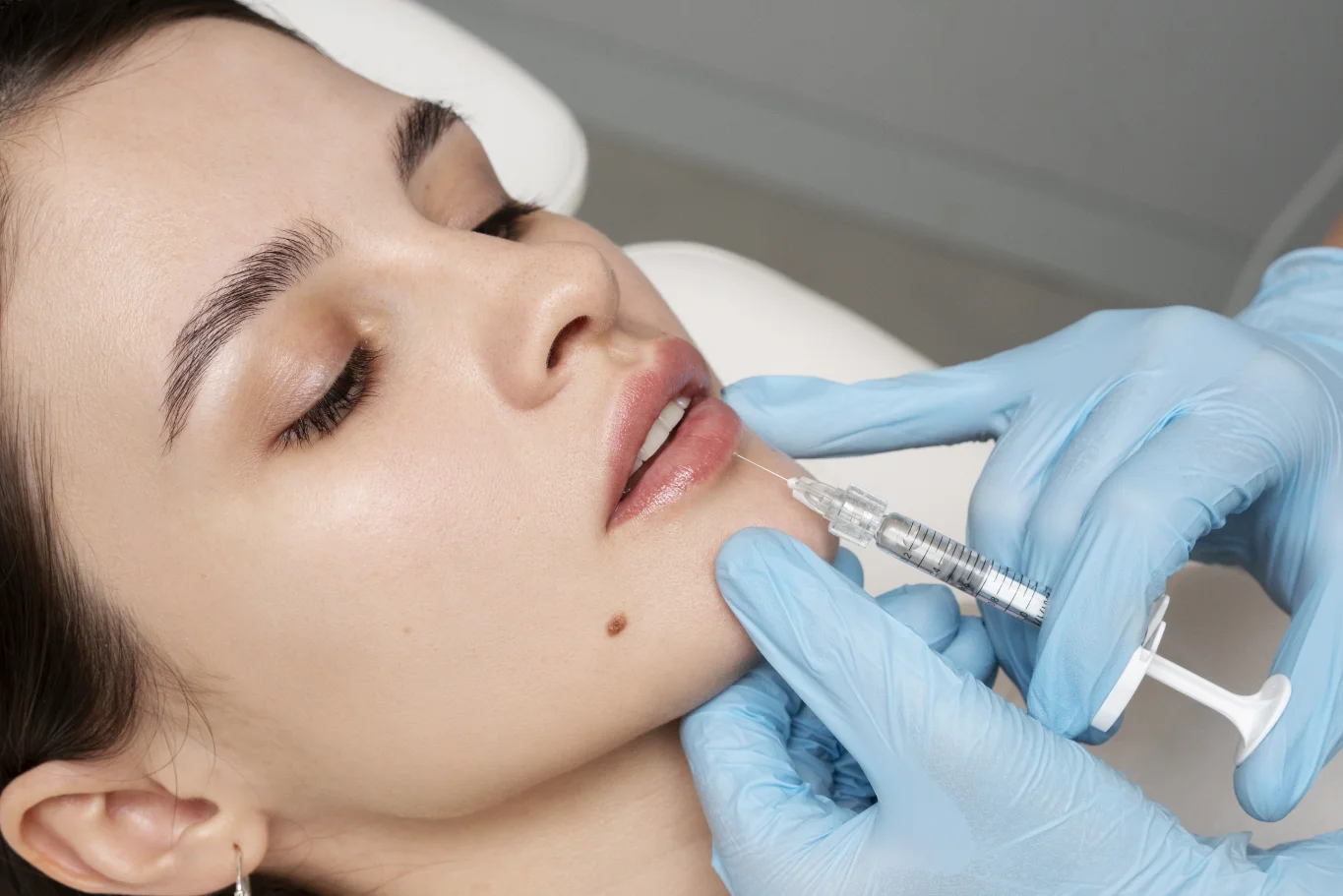
Dermal fillers treat facial volume loss and structural imbalance. The most important concept to understand before any filler treatment is that the face ages as a system, not one feature at a time. Volume is lost from multiple areas simultaneously — the cheeks, temples, jawline, and chin — and treating one in isolation without understanding how it connects to the others often produces a result that looks off even if each individual area is technically well done.
The sequence that produces the most natural outcome for most patients is midface first, then lower face. This isn’t arbitrary — it reflects how the face loses volume with age and how structural support in one zone affects the appearance of adjacent zones.
How Hyaluronic Acid Filler Works
The most common filler type used in Dubai and globally is hyaluronic acid (HA). HA is a naturally occurring substance found in skin and connective tissue; the version used in fillers is synthesised through bacterial fermentation rather than derived from animal sources. It integrates into tissue, holds water, and adds volume where it’s placed. HA fillers come in different consistencies — stiffer, more cross-linked gels for structural areas like the chin and jaw; softer, more mobile gels for the lips and tear trough.
HA fillers are reversible. Hyaluronidase enzyme can dissolve HA filler quickly if a result isn’t right or if a complication occurs. This reversibility is one of the clinically important advantages of HA over other filler types, and it’s why HA dominates the Dubai market for facial contouring.
The Midface: Where to Start
The midface — specifically the cheekbone region and the soft tissue just below it — is the structural pillar of the lower two-thirds of the face. When volume is lost here, several things happen simultaneously: the cheeks flatten, the nasolabial folds deepen, the under-eye area appears more hollow, and the lower face begins to look bottom-heavy because the structural support above it has reduced.
Midface filler restores this foundation. A well-placed cheek filler lifts the midface, reduces the nasolabial fold indirectly by lifting the tissue above it rather than filling the fold itself, and improves the relationship between the under-eye and cheek zone. In many patients, treating the midface alone resolves concerns about the nasolabial area without ever touching it — which is why experienced injectors start here rather than injecting directly into the fold.
The typical volume used for midface restoration is 0.5 to 2ml per side, depending on the degree of deflation. Results last twelve to eighteen months depending on the product, placement depth, and individual metabolism.
The Jawline: Structure and Definition
Jawline filler addresses blunting of the mandibular angle, early jowling, and the loss of a clear transition between the lower face and the neck. Product is placed along the mandibular body and angle using a cannula, which reduces bruising risk and allows the injector to trace the bone structure smoothly.
For women, the aesthetic goal is typically a refined, softly defined jaw with improved lower face symmetry. For men, the goal is more often a sharper angle and stronger definition — and the product choices and volumes used are adjusted accordingly, typically stiffer gels at higher volumes.
One important sequencing consideration: if the midface has not been addressed first, a well-treated jawline can still look disproportionate. Supporting the midface before or alongside the jawline produces a result that reads as balanced rather than overdone at the bottom.
Jawline filler typically lasts twelve to eighteen months. In high-movement areas — the body of the mandible where chewing creates mechanical stress — the product degrades faster than in lower-movement zones.
The Chin: Projection and Profile
The chin is the anterior focal point of the lower face. A recessed or short chin makes the nose look larger than it is, reduces the apparent definition of the jawline, and creates a profile that lacks balance between the upper and lower face. Chin filler adds forward projection (sagittal projection) or vertical height depending on the placement technique — a precise bolus placed at the pogonion (the most anterior point of the chin) projects it forward; fanning technique can also add height.
Chin filler is one of the most frequently combined treatments in lower face contouring precisely because it completes the lower face structure that the jawline defines. Treating the jaw without the chin often leaves the profile incomplete; the two together produce the clear separation between face and neck that patients typically describe when they say they want a “more defined” look.
Reversible with hyaluronidase. Duration is typically twelve to twenty-four months depending on the product and the degree of movement in the mental fold area.
What to Expect: Appointments, Downtime, and Maintenance
A filler appointment for one area — midface, jawline, or chin — takes thirty to sixty minutes including numbing, mapping, and treatment. Most injectors use a topical anaesthetic cream beforehand. Cannula technique reduces the number of entry points and the bruising risk compared to multiple needle passes.
After treatment, mild swelling is expected for twenty-four to forty-eight hours. Bruising is possible and more common in areas with more vasculature, particularly around the jaw. Most people are socially presentable the next day. Avoiding strenuous exercise, extreme heat, and alcohol for twenty-four hours reduces swelling duration.
For first-time filler patients, a conservative approach — less volume than you think you need, reviewed at two to four weeks — is consistently better than a single large treatment. Filler integrates slightly differently in different tissue environments, and a two-week review allows the injector to assess the result and add more if needed rather than starting with an amount that may be more than the anatomy requires.
Maintenance is typically annual for most areas, though individual metabolism, product choice, and area dynamics affect longevity. Some areas — like lips and the angle of the jaw — break down filler faster than the chin or midface.
For aftercare covering the post-injection period, see the Dubai Aftercare Guide.
For patients interested in autologous options including PRP, see PRP and Autologous Options in Dubai.