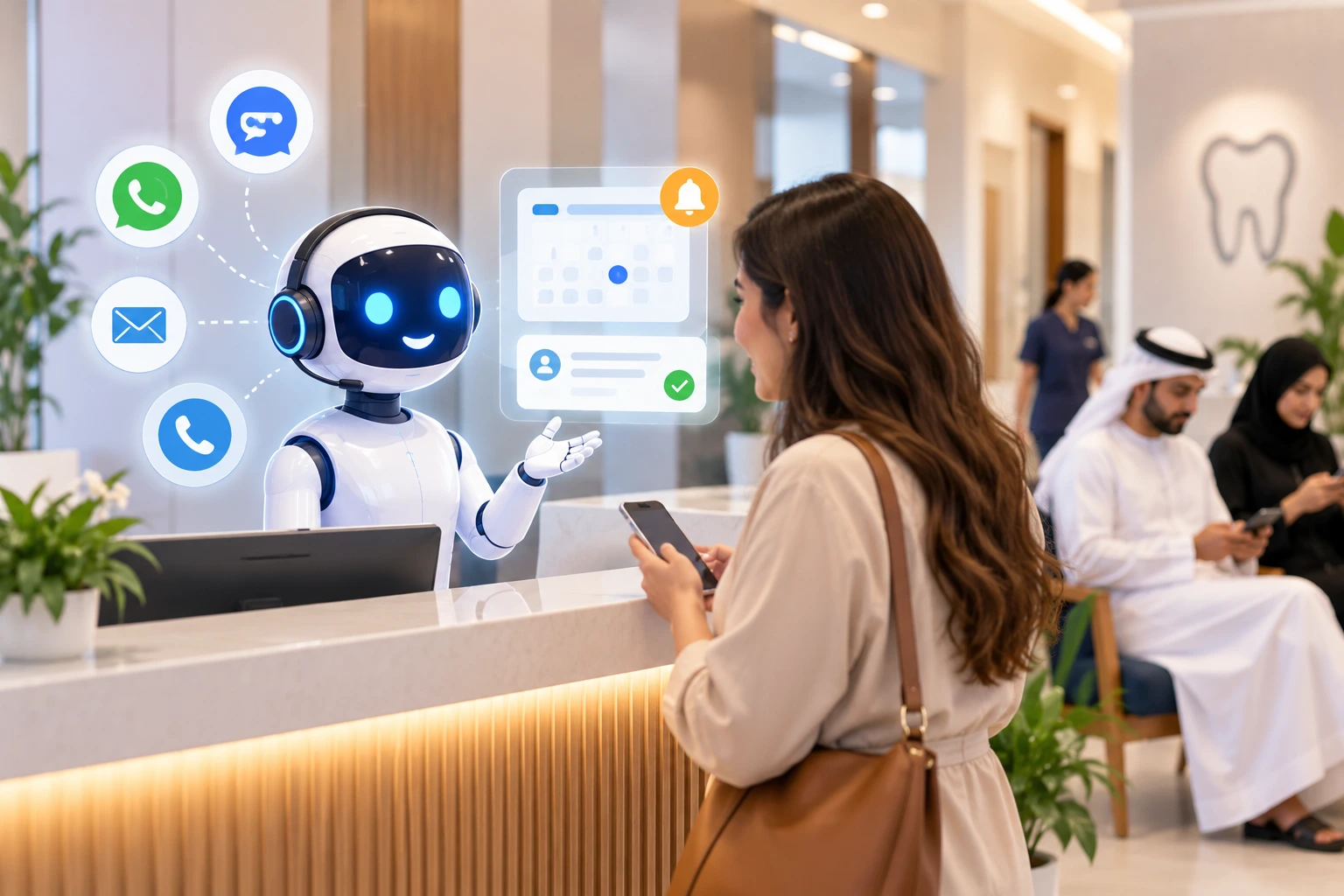
Clinic owners looking for an AI receptionist now have plenty of options, and almost all of them promise the same things: 24/7 answering, natural conversations, more bookings. On a sales call, they can sound identical.
They aren’t. Some were built for restaurants and hair salons and adapted for healthcare as an afterthought. Some sound great in English and struggle in Arabic. Some take messages but can’t actually book. And some send your patients’ conversations to servers on the other side of the world.
This guide walks you through how to choose an AI front desk for your clinic in five steps, with a test script you can use on any vendor, the pricing models to understand, and the red flags that should end a conversation. Yes, we sell one. We’d rather you choose well, even if it’s not us.
Step 1: Define what you actually need
Before you speak to any vendor, answer these questions with your team. They’ll keep you focused when every demo looks impressive.
- Which channels? Phone calls, WhatsApp, or both? Do you need Instagram or website chat too?
- Which hours? After hours only, peak overflow, or every call, all day?
- What should it do? Answer questions only, or also book, reschedule, cancel, send reminders and follow up?
- Which booking system do you use, and does it need to connect directly?
- Which languages do your patients speak?
- How many locations, doctors and services? Complexity matters.
- What must always go to a human? Clinical questions, complaints, VIPs, specific services.
- What does success look like? Fewer missed calls, faster WhatsApp replies, more bookings, fewer no-shows? Pick two or three measurable goals.
Write the answers down. That’s your requirements list.
Step 2: Check the must-haves for UAE clinics
These aren’t nice-to-haves. If a vendor can’t deliver them, move on.
- Built for healthcare. It should understand medical services and terminology, follow healthcare rules, and never give medical advice.
- Real Arabic, not just English. It should understand spoken Gulf Arabic and patients who mix Arabic and English, and reply naturally in both.
- Phone and WhatsApp. In the UAE, a phone-only tool covers half your patients’ conversations.
- Direct booking. It should check live availability and book, reschedule and cancel in your calendar, not just take a message.
- Patient data in the UAE. Health data related to care in the UAE generally has to be stored and processed inside the country. Ask about storage and processing, including speech recognition and the AI model. Our guide to patient data privacy in the UAE explains why.
- Clear handover to humans. Transfers, notifications and summaries, so patients never get stuck and your team has context.
- Emergency handling. It must recognise urgent situations and direct callers to emergency care.
- Control over what it says. You should be able to update services, prices, FAQs and rules without waiting weeks.
- Reporting. Call volumes, bookings, handovers and common questions, so you can see the impact.
- Local setup and support. Someone who understands UAE clinics, helps configure it, and is reachable when you need them.
Step 3: Test it yourself, with a real script
Demo videos are edited. Live calls aren’t. Ask every vendor for a test number set up with a sample of your clinic’s information, then run through this script yourself, and ask a colleague to do the same.
Booking basics
- Book a new appointment with a specific doctor.
- Change your mind halfway: “Actually, can it be Thursday instead?”
- Reschedule, then cancel an existing appointment.
- Check the booking actually appears correctly in the calendar.
Language
- Call in Arabic, then in English.
- Mix both in one sentence.
- Use a name that’s easy to mishear, and see if it confirms the spelling.
Real-world messiness
- Interrupt it mid-sentence.
- Ask two questions at once.
- Call from a noisy place, like a car or a café.
- Send a WhatsApp voice note.
Boundaries
- Describe a symptom and ask what you should take. (It should not give advice.)
- Describe something that sounds urgent. (It should direct you to emergency care.)
- Ask to speak to a person. (It should hand over smoothly.)
- Ask about something it can’t know, like a price that isn’t listed. (It should say so, not guess.)
Score each test as pass, partial or fail. Patterns appear quickly.
Step 4: Understand pricing and contract terms
AI front desk pricing varies a lot between providers. Common models include:
- Flat monthly subscription, sometimes tiered by number of locations or features
- Usage-based pricing, per call minute, per conversation or per booking
- Setup or onboarding fee for configuration and integrations
- Add-ons for extra channels, languages or advanced reporting
To compare fairly, ask each vendor to price the same scenario: your expected monthly call and message volume, your channels, your locations and your integrations. Then compare the total yearly cost, not the headline monthly fee. Our comparison of AI vs human receptionists shows how to weigh it against staffing costs.
Contract questions to ask
- How long is the minimum commitment?
- Is there a trial or pilot period?
- What happens to our data if we leave? Can we export it, and will it be deleted?
- Who owns the call recordings and transcripts?
- What are the support hours and response times?
- What happens if the service goes down?
Step 5: Run a pilot and measure it
The best way to choose is to try it on real patients, in a controlled way.
- Start small. For example, after-hours calls only, or one branch, or WhatsApp only.
- Record a baseline for the month before: missed calls, WhatsApp response time, bookings and no-shows.
- Review conversations every week with the vendor. Fix wrong answers, missing information and awkward handovers.
- Ask your team what changed for them. Fewer interruptions? More context on handovers?
- Compare after 30 to 60 days against the baseline and your goals from Step 1.
If it’s working, expand gradually: more hours, more channels, more locations.
Red flags
- “It can do everything, including triage.” An AI front desk that offers medical advice is a liability, not a feature.
- Vague answers about where data goes. “It’s in the cloud” is not an answer.
- No live test. If you can only see videos, ask why.
- Arabic “coming soon”. For UAE clinics, that’s a dealbreaker.
- Only takes messages. Without direct booking, it moves work around instead of removing it.
- No way to reach a human. Patients must always be able to get to a person.
- Long lock-in with no pilot. Confident vendors let you prove the value first.
- Generic setup. If it doesn’t know your doctors, services and policies, it will give generic, sometimes wrong, answers.
A simple scorecard
Score each vendor from 1 to 5 on each line, and weight what matters most to your clinic.
| Criterion | Vendor A | Vendor B | Vendor C |
|---|---|---|---|
| Built for healthcare | |||
| Arabic quality (spoken and written) | |||
| English quality | |||
| Phone and WhatsApp | |||
| Direct booking integration | |||
| Handover to staff | |||
| Emergency handling | |||
| UAE data storage and processing | |||
| Ease of updating information | |||
| Reporting | |||
| Local support | |||
| Total yearly cost | |||
| Pilot and contract flexibility |
Frequently asked questions
What is an AI front desk for clinics?
It’s software that uses conversational AI to answer a clinic’s phone calls and messages, answer common questions, book and reschedule appointments and send reminders, while handing anything clinical or complex to staff. It’s also called an AI receptionist. Read more in what an AI receptionist is and how it works.
What should I look for in an AI receptionist for my clinic?
A tool built for healthcare, strong Arabic and English, phone and WhatsApp support, direct booking into your calendar, patient data stored and processed in the UAE, smooth handover to humans, correct emergency handling, easy updates and good reporting.
How do I test an AI receptionist before buying?
Ask for a test line with your clinic’s information and run real scenarios: booking, rescheduling, mixing languages, interrupting, asking for medical advice, describing an emergency and asking for a person. Then run a 30 to 60 day pilot.
How is AI receptionist pricing usually structured?
Common models include a monthly subscription, usage-based pricing per call or conversation, a setup fee and optional add-ons. Compare the total yearly cost for your expected volume rather than the headline price.
How long does it take to set up an AI front desk?
It depends on your booking system, number of locations and services, and how much information needs to be prepared. A focused pilot is usually much quicker than a full rollout.
Can I start with just after-hours calls?
Yes, and it’s often a smart way to begin. After-hours calls are where many clinics lose the most bookings, and the impact is easy to measure.
The bottom line
Choosing an AI front desk isn’t about finding the most impressive demo. It’s about finding the one that works for your clinic, your patients and your rules: real Arabic, real bookings, patient data kept in the UAE, safe boundaries and a smooth path to your team.
Define what you need, check the must-haves, test it yourself, compare total costs and prove it with a pilot. Do that, and you’ll make the right choice, whoever you choose.
We’d be glad to be on your shortlist. Talk to Rābetica’s voice agent in Arabic or English, put it through the test script above, or book a 30-minute demo.