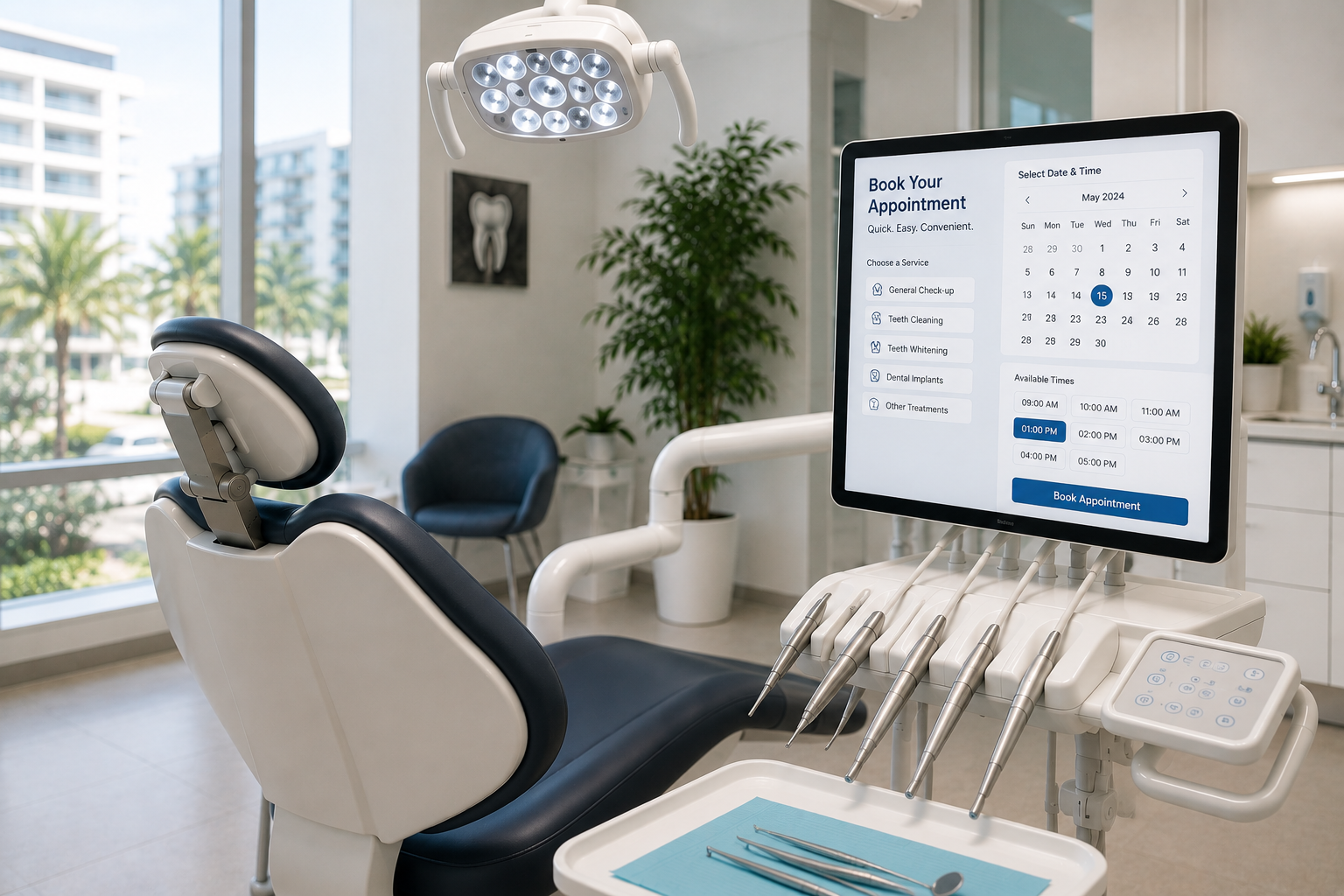
Every missed phone call at a Dubai clinic is a patient who might book with a competitor instead. Front desk teams juggle a full waiting room, an insurance query on line one, and a new patient trying to get through on line two, and something has to give. For many clinics, what gives is the phone. A medical answering service exists to close that gap, and for clinic owners in Dubai deciding whether to outsource this function, the decision involves more than just picking a vendor. It also means understanding DHA and MOH rules around patient data, something almost no guide written for the US or UK market accounts for.
This guide breaks down what a medical answering service actually does, how the different models compare, what it costs in the UAE, and what Dubai clinic owners specifically need to check before signing a contract.
What Is a Medical Answering Service
A medical answering service is a call handling solution that manages incoming patient calls on behalf of a clinic. Instead of every call landing on an already stretched front desk, calls are answered by trained agents, an AI voice system, or a combination of both, working from scripts and protocols the clinic approves in advance.
At a basic level, the service picks up the phone, takes a message, and passes it along. At a more advanced level, it can book and reschedule appointments directly into the clinic’s calendar, answer common questions about services and pricing, flag urgent calls for immediate escalation, and provide coverage after hours, on weekends, and during public holidays when the clinic itself is closed.
The service can run in a few different ways. Some clinics use it only as overflow support during peak hours. Others use it purely for after-hours coverage, so nothing falls through the cracks between closing time and the next morning. Larger practices sometimes hand over the phones entirely, treating the answering service as their full-time front desk.
Why Dubai Clinics Are Missing Patient Calls
The pattern behind missed calls is consistent across healthcare markets, and Dubai clinics are not an exception. Industry research on medical practices puts the average missed call rate at close to a quarter of all incoming calls, with the number climbing during lunch hours when front desk coverage thins out. A large share of callers who reach voicemail simply hang up rather than leave a message, and many never call back. For a Dubai clinic competing in a dense market like Jumeirah, Downtown, or Dubai Healthcare City, that caller often just moves on to the next clinic in their Google search results.
The cost is not only the missed booking. Patients form an impression of a clinic’s reliability from the very first phone call. A rushed, inconsistent, or unanswered call signals disorganization before the patient has even walked through the door. In a market where reviews and word of mouth carry real weight, that first impression compounds over time.
Peak season adds another layer. Dubai clinics see call volume spike during flu season, before school terms, and around major holidays, exactly when front desk staff are already stretched thin managing a full clinic.
Live Agents vs AI vs Hybrid Models
Clinic owners generally choose between three models when outsourcing call handling.
Live agent services use trained human operators who answer calls under the clinic’s name, following approved scripts and escalation protocols. This model tends to handle nuanced or emotional calls better, since a caller who is anxious or in pain often responds better to a human voice than an automated one.
AI-powered answering services use voice technology to greet callers, answer routine questions, and book appointments without a human agent on the line. These systems have improved significantly and now integrate with practice management software and electronic health record systems, letting the AI check real-time appointment availability rather than just taking a message. The tradeoff is that AI still handles unusual or highly emotional calls less gracefully than a trained person.
Hybrid models combine the two, using AI to handle routine volume and instantly escalate anything urgent, unusual, or clinically sensitive to a live agent or the clinic’s own staff. For most Dubai clinics, this hybrid approach offers the best balance of cost control and patient experience, since it keeps a human in the loop for the calls that matter most.
Must-Have Features for a UAE Medical Answering Service
Not every answering service built for a general business is suited to healthcare, and not every healthcare-focused service is suited to the UAE market. Clinic owners evaluating vendors should look for the following.
Around-the-clock availability, so calls are answered consistently whether it is midday, midnight, or a public holiday. Bilingual or multilingual support, since Dubai’s patient base spans Arabic, English, and several other languages, and a service that can only operate in English will lose patients on the first sentence. Integration with the clinic’s existing scheduling system or practice management software, so appointments booked over the phone sync automatically rather than requiring manual entry. Clear escalation protocols, agreed with the clinic in advance, so a call describing chest pain or a medical emergency is routed immediately rather than logged as a routine message. Custom scripting by specialty, since a fertility clinic, a dental practice, and a dermatology clinic each field very different questions and need agents briefed accordingly.
DHA and MOH Compliance: What Dubai Clinics Must Check Before Outsourcing
This is the part most generic guides on medical answering services miss entirely, because they are written for the US market and built around HIPAA. Dubai clinics operate under a different legal framework, and it changes what is and is not acceptable in a vendor contract.
Federal Law No. 2 of 2019 on the Use of Information and Communication Technology in the Health Fields, generally referred to as the ICT Health Law, governs how patient health information is collected, processed, and stored across the UAE. One of its most important provisions for outsourcing decisions is a data localization requirement. Patient information generated in the UAE generally cannot be stored, processed, or transferred outside the country unless that arrangement has specific approval from the relevant health authority. This matters directly for answering services, because many popular platforms in this space are built on servers based in the US or Europe. Before signing with any vendor, a Dubai clinic needs to confirm exactly where call recordings, patient messages, and appointment data are stored and processed.
The DHA’s own Health Data Protection and Confidentiality Policy adds further requirements on top of the federal law, including strict rules on data retention, incident reporting timelines if a breach occurs, and confidentiality obligations that extend to any third party handling patient information on the clinic’s behalf, including an outsourced answering service. In practice, this means the answering service is not just a phone vendor. It becomes a data processor under UAE law, and the clinic remains responsible for making sure that processor meets DHA standards.
Before signing a contract, Dubai clinic owners should ask every vendor these questions directly: where is patient data physically stored and processed, is there a written confidentiality agreement or data processing addendum covering DHA requirements, what is the vendor’s breach notification process and timeline, and can the vendor provide documentation showing UAE-based data handling or the specific approval required to operate otherwise. A vendor that cannot answer these questions clearly is not ready for a healthcare contract in this market, regardless of how polished its sales pitch sounds.
How Much Does a Medical Answering Service Cost in Dubai
Pricing in this space typically follows one of two structures: a flat monthly fee based on expected call volume and coverage hours, or a per-minute rate charged only for time actually spent on calls. International benchmarks for HIPAA-style medical answering services generally range from a few hundred dollars a month for after-hours-only coverage on a small practice, up to well over a thousand dollars a month for full-time, high-volume coverage with appointment booking included. Per-minute rates for healthcare-specific services tend to run close to a dollar or more per minute, reflecting the additional training and compliance built into the service compared to a general business answering line.
Dubai clinics should expect to convert and negotiate these figures in AED, and should treat any quote that seems unusually low with some skepticism, since healthcare-trained agents and compliant infrastructure cost more to deliver than a generic call center line. It is worth asking vendors for a breakdown of what is included at each price tier, since after-hours-only coverage, full daytime overflow support, and complete outsourced reception are priced very differently even within the same platform.
How to Choose the Right Medical Answering Service for Your Clinic
Start by defining the actual gap. A clinic that only struggles after 6pm needs a very different service than one that is missing calls during a packed Tuesday morning. Request a trial period or a recorded sample call before committing, since the quality of the greeting and the accuracy of information given to a caller says more than any feature list. Ask specifically about DHA and MOH compliance using the questions outlined above, and get the answers in writing. Check whether the vendor has experience with clinics in your specialty, since a service used to handling general practice calls may not know how to triage a fertility patient’s question or a dermatology booking correctly. Finally, confirm how the service integrates with your existing systems, since a booking that has to be manually re-entered defeats much of the purpose of outsourcing in the first place.
Signs Your Clinic Needs One Now
A few signals tend to show up before a clinic owner consciously decides to outsource. Front desk staff are consistently behind on callbacks by the end of the day. Online reviews mention difficulty reaching the clinic by phone. Call volume spikes predictably at certain times, such as lunch or right after opening, and those calls routinely go unanswered. New patient inquiries are being lost to competitors who simply answer faster. Staff turnover at the front desk keeps disrupting continuity, leaving gaps in coverage during the transition. Any one of these on its own might not justify the cost of outsourcing, but two or three together usually mean the clinic is already losing more in missed bookings than an answering service would cost to run.
Conclusion
A medical answering service can solve a real and measurable problem for Dubai clinics, but the decision should not be made on price alone. Between live agent, AI, and hybrid models, and against a compliance backdrop that most vendors built for other markets have never had to think about, Dubai clinic owners need to vet answering services the same way they would vet any other party handling patient information. Ask the compliance questions early, confirm exactly where data lives, and choose a model that matches the specific hours and call volume your clinic actually struggles with.