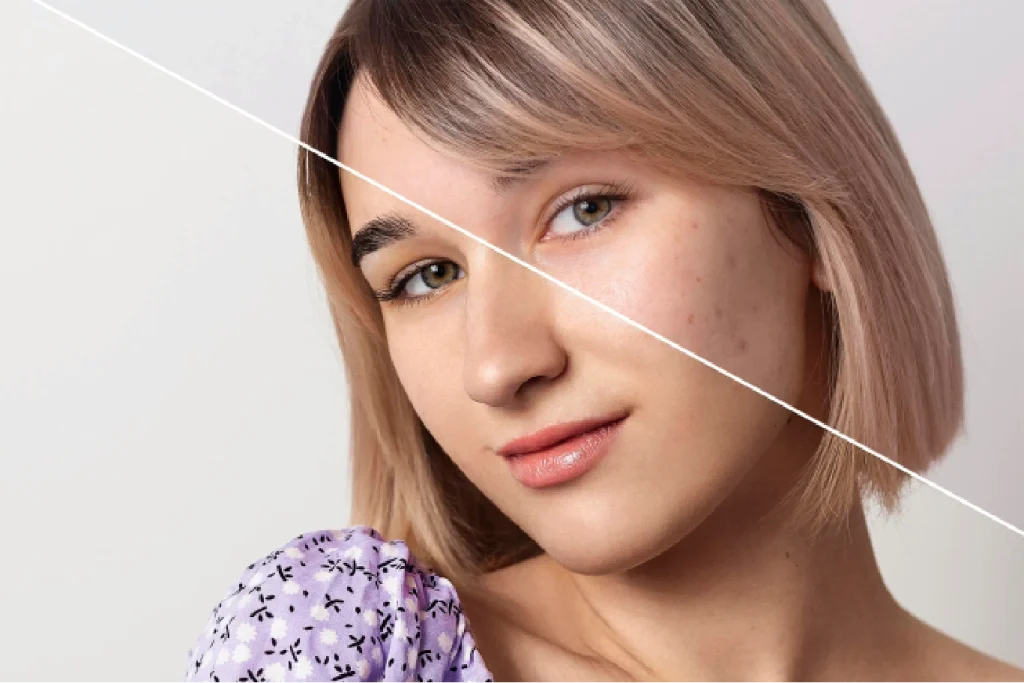
If you have darker skin and you’ve tried treating acne scars before, there’s a decent chance the treatment made things worse before it made them better. That’s not unusual, and it’s not a reflection of your skin being difficult. It’s a reflection of the fact that most acne scar protocols were developed for lighter skin types, and the ones designed for Fitzpatrick IV–VI skin require a genuinely different logic.
Dubai’s patient population skews heavily toward skin types IV, V, and VI. South Asian, Middle Eastern, East African, and Southeast Asian skin tones are the norm here, not the exception. And yet a lot of clinics in the city still run the same protocols they’d use on lighter skin and hope for the best. This guide explains what makes darker skin behave differently, what treatments work safely, and what to push back against when a clinic recommends something that doesn’t sound right.
Why Darker Skin Responds Differently to Treatment
The core issue is melanocyte reactivity. Melanocytes are the cells that produce pigment, and in Fitzpatrick IV–VI skin they are more sensitive to inflammation. When skin with higher melanin content experiences trauma, whether that’s a breakout, a needle, or a laser pulse that was set too high, the inflammatory response triggers excess pigment production. The result is post-inflammatory hyperpigmentation (PIH): a flat, dark mark left behind after the wound has healed.
In lighter skin, the breakout itself is usually the main event. In darker skin, the flat brown or grey mark that follows can linger for months and is often what patients find most distressing. Treating the scar aggressively, with too much heat or too high a laser energy level, risks generating more of exactly that.
There is also a higher tendency in types V and VI toward keloid and hypertrophic scarring, where the skin overproduces scar tissue. This isn’t universal, but it changes the risk calculation for any treatment involving significant tissue injury.
What to Avoid
Certain treatments that work well on lighter skin carry real risks for darker skin when performed without appropriate calibration.
Ablative fractional CO2 laser at standard settings removes the top layers of skin and triggers significant collagen production, which is exactly what you want for atrophic scars. On lighter skin it is one of the most effective tools available. On darker skin, if the energy levels are not adjusted downward and the operator isn’t experienced with melanin-rich skin, it frequently causes PIH or hypopigmentation. It can be used safely in the right hands with the right settings, but it should not be the first treatment offered.
IPL (intense pulsed light) targets melanin to treat pigmentation. For darker skin, the risk of burns and PIH is significant enough that most experienced clinicians avoid it entirely for Fitzpatrick IV–VI.
Deep chemical peels at high concentrations carry similar risks. Superficial and medium-depth peels can be used safely, but the protocol needs to be adjusted for your skin tone.
Any treatment where the operator doesn’t ask about your Fitzpatrick type before starting is a concern. If a clinic does a consultation without discussing your skin’s pigment response history, that’s worth paying attention to.
What Works Well
RF microneedling is arguably the safest energy-based option for darker skin. The radiofrequency energy is delivered through insulated needles directly into the dermis, bypassing the melanin-rich epidermis. Because the surface of the skin doesn’t absorb as much heat, the PIH risk is substantially lower than with laser. It still improves collagen remodelling effectively. Most patients with Fitzpatrick IV–VI skin tolerate it well at conservative parameters, and results build progressively across four to six sessions.
Standard microneedling (without RF) creates controlled micro-injuries that stimulate collagen without significant heat involvement. The PIH risk is low when performed correctly. It’s a reasonable starting point, particularly at the beginning of a programme when you’re still establishing how your skin responds.
Non-ablative fractional laser (1550 nm, 1927 nm) works by coagulating tissue without ablating the surface, which means there’s no open wound to trigger a pigment response at the same level as ablative lasers. The evidence for its safety in Fitzpatrick IV–VI skin is stronger than for ablative options. It typically requires more sessions for equivalent results, but the trade-off is a significantly better safety profile.
Superficial chemical peels using mandelic acid, lactic acid, or low-concentration glycolic acid can address the PIH component effectively and complement structural treatments. The key is keeping concentrations low and monitoring the skin’s response carefully between sessions.
Sun protection is not a treatment, but it is the most important thing you can do to prevent PIH from getting worse. UV exposure stimulates melanocyte activity, which deepens existing marks and creates new ones. SPF 50 every day, including on cloudy days and indoors near windows, is non-negotiable for any scar programme in Dubai’s environment.
How a Safe Programme Is Structured
For darker skin, the principle is: start conservatively, observe the skin’s response, and build from there. The first session should use lower parameters than you might otherwise choose. Four to six weeks later, the response gives you the data you need to calibrate the next session.
A typical starting plan for Fitzpatrick IV–VI in Dubai:
Sessions one and two: RF microneedling at conservative settings, combined with a topical home routine of vitamin C serum and daily SPF. Assess PIH risk after session one before proceeding.
Sessions three and four: Introduce a superficial peel if the PIH component is significant. Adjust RF parameters based on how the skin responded to the first two sessions.
Sessions five and six: If the skin has responded well, this is when a non-ablative fractional laser can be introduced for any remaining structural scarring that hasn’t improved sufficiently.
For a full breakdown of sequencing across a 3-month programme, including how each modality fits in, see 3-Month Acne Scar Reset in Dubai.
Managing PIH Alongside Scar Treatment
PIH is often treated as a separate concern, but in darker skin it’s inseparable from the scar programme. If you develop PIH after a session, continuing with the same parameters makes it worse. The response should be to reduce the treatment intensity, extend the interval between sessions, and add topical support.
Topical ingredients that help: vitamin C (L-ascorbic acid at 10–20%), azelaic acid, niacinamide, and, where tolerated, retinoids at low concentrations used at night. These don’t replace in-clinic treatment for structural scars, but they do a lot of the heavy lifting on pigmentation between sessions.
For a complete guide to managing PIH specifically, see PIH After Acne and Procedures in Dubai.
How Many Sessions to Expect
Darker skin typically needs more sessions to reach the same improvement level, because you’re working with lower per-session energy to protect the epidermis. Four to six sessions is a more realistic baseline than the three that might apply to lighter skin. Some patients need more depending on scar severity and depth.
For a breakdown by scar type and skin tone, see How Many Sessions Do You Need for Acne Scars in Dubai?
Questions Worth Asking Before You Book
Ask the clinic how many patients they treat with Fitzpatrick IV–VI skin. Ask which laser they use for darker skin and why. Ask whether they adjust RF parameters for melanin-rich skin or use a standard setting. Ask whether they do a patch test before full treatment. None of these are unreasonable questions, and a clinic experienced with darker skin should be able to answer them without hesitation.